A hairline crack along a Centennial slab, with a damp patch of carpet nearby that was not there last week, often means the connection has cracked. The IICRC-standard local crew traces it quickly, without delay.

In the home crews trace the condensate line's path, checking for both standard clogs and stress points related to expansive clay soil movement common across this suburb's slab and basement construction.
Once the source is confirmed crews stop the active leak, remove standing water, and pull out saturated flooring, drywall, or insulation, protecting what can still be salvaged, so the repair addresses the actual cause, not just the symptom.
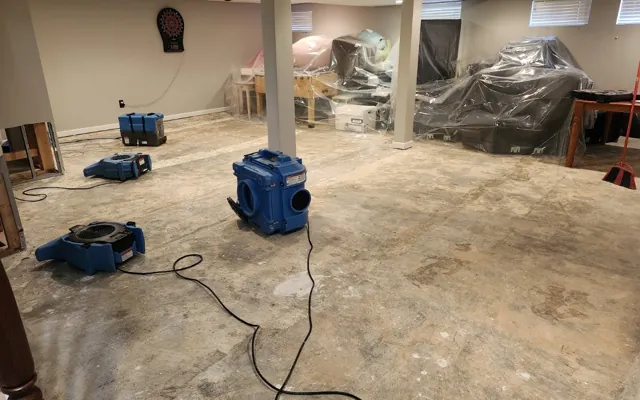
Air movers and dehumidifiers dry the space to IICRC targets with daily logged readings, then crews rebuild affected materials to match the home's existing finish, which keeps the rest of the job on schedule.

HVAC condensation damage in Centennial typically runs $1,200 to $6,000, driven by how long the drip went unnoticed, whether it soaked a finished ceiling, and how much drywall, insulation, and flooring must be replaced. Clearing or repairing the condensate line is a separate HVAC service. Because slow, hidden leaks are sometimes excluded, coverage varies; crews document the loss and bill your insurer directly when it applies.
Centennial is one of the largest suburbs in the area, built out almost entirely between the 1970s and 2000s with mile after mile of two-story subdivisions sitting on expansive bentonite clay. That soil movement is a quiet driver behind a lot of slab cracking and pipe stress across the suburb, on top of the usual finished-basement and sprinkler-line risks common to newer construction. Expansive bentonite clay soil across this large suburb drives steady slab cracking and pipe stress, and combined with finished basements and sprinkler lines common to newer construction, a condensate leak here can have more than one contributing factor. From Centennial, crews also cover nearby Mission Viejo, Lakeshore, Dam East-West, Heather Gardens, East Ridge-Ptarmigan Park, Heather Ridge. See every neighborhood and town on the full service area page.
See all areas servedEvery loss is photographed, measured, and logged from the first visit, so the paperwork holds up with your insurance carrier.
Technicians follow recognized IICRC drying standards and prove the work with daily moisture readings, not guesswork.
Emergency dispatch any hour of the day or night, with a real crew on the way, not a callback in the morning.
A real crew dispatched any hour, not a callback in the morning.
Trained technicians following recognized IICRC drying standards.
Truck-mounted, portable, and submersible for any size loss.
The loss is documented and billed to the carrier directly.
Water in Centennial, CO crawlspaces can rot framing and subfloors within days if not addressed immediately by professionals. Crews extract the water quickly, dry the entire cavity with industrial dehumidifiers, and monitor moisture levels until the structure reaches verified dry conditions, usually three to five days total.
Emergency water extraction in Centennial, CO typically costs between $1,200 and $5,500 depending on water volume and how far it spread into finished spaces and structural cavities. Sudden losses from burst pipes and storms are usually covered by homeowner insurance, and crews handle all documentation.
Crews are on call 24 hours a day and can be on the way to Centennial within the hour.
Call (720) 807-8182